KangbeiJing: Plasma Air Purifier by China Smart Manufacturing with Technology, Standards, Assurance, Scale, Craftsmanship, and Development

Views: 0 Author: Site Editor Publish Time: 2026-07-02 Origin: Site


From check-in to check-out: how voice-controlled air purification transforms the guestroom into a wellness-aware space
What Guests Actually Notice
When travelers review hotels, they rarely mention air quality by name — but they describe it constantly. “The room smelled a bit stale when we arrived.” “The bathroom had a faint odor the whole stay.” “The air felt heavy and I didn’t sleep well.” These are air management failures expressed in the language of guest experience.
The 2026 summer travel season is already underway. The Paper recently published a summer safety advisory reminding students and families to check hotel emergency exits — a reminder that security, hygiene and comfort are the three pillars of accommodation quality. Among these three, comfort is the most subjective. It is also the one most directly shaped by the air a guest breathes.
For hotel operators, the challenge is clear: how do you consistently deliver a fresh, comfortable guestroom air experience without increasing housekeeping workload or relying on guests to manually operate unfamiliar equipment?
The Intelligence Gap in Guestroom Air Management
Most hotel guestrooms already contain multiple climate-control devices: a thermostat for the HVAC system, possibly a standalone fan or heater, occasionally a portable air purifier placed by housekeeping. The problem is not a lack of equipment — it is the friction between the guest and the equipment.
Guests do not want to read instruction manuals. They do not want to decipher icon-based control panels in a dimly lit hotel room after a long journey. They want to say “make the room comfortable” and have it happen.
This is the insight behind Kangbeijing’s KJ-A9: a voice-controlled air health management terminal designed for hospitality environments where simplicity of interaction is as important as purification performance.
KJ-A9: Voice-First Air Management for the Modern Guestroom
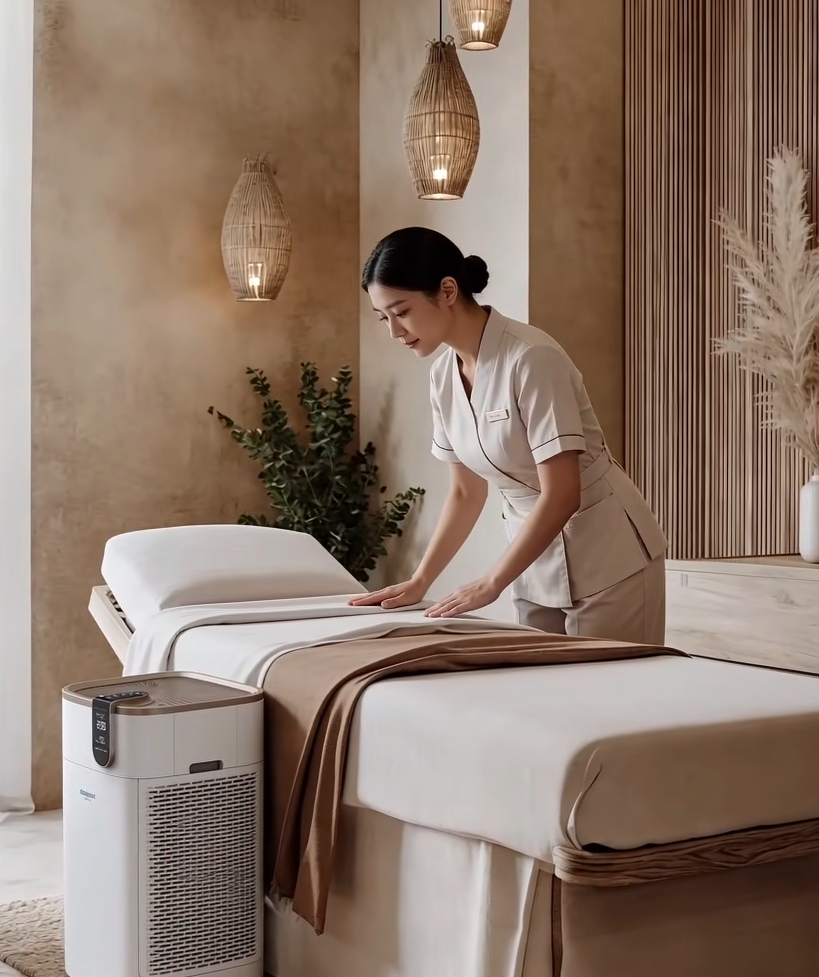
The KJ-A9 is a compact, desk- or console-mountable air management terminal with an integrated voice interaction system. A guest arriving in their room can simply say — in their language — “turn on air purification,” “set to sleep mode,” or “what is the air quality in this room?” The device responds with both voice confirmation and a discreet visual indicator.
Beyond the convenience for guests, the voice-first design solves several operational problems for hotels:
Eliminates equipment misuse: guests are less likely to unplug or ignore a device they can control conversationally, improving actual utilization rates.
Reduces housekeeping call-backs: when a guest can verbally check air quality or adjust settings themselves, front-desk calls about “stuffy room” or “AC smell” decrease.
Creates a differentiated brand impression: in a market where most mid-to-upscale hotel rooms look similar, a voice-interactive wellness feature provides a memorable touchpoint that review sites and social media tend to amplify.
The KJ-A9’s purification core includes multi-stage filtration optimized for the pollutant profile of hotel guestrooms: fine particulate matter from bedding fibers and outdoor air infiltration, volatile organic compounds from cleaning products, and general odor control. The device operates at noise levels suitable for sleep environments and includes a dedicated night mode with dimmed indicators.
Positioning Air Management as a Hospitality Feature
Kangbeijing’s recommendation to hotel operators is to stop thinking of air purification as back-of-house maintenance and start presenting it as a front-of-house amenity — comparable to premium bedding, a well-designed workspace or a high-quality shower:
List “voice-controlled air purification” alongside other in-room amenities on booking platforms and the hotel’s own website.
Include a one-line instruction card — “Say ‘Hello, set air to sleep mode’ for a restful night” — on the nightstand, rather than a technical manual.
Train front-desk staff to mention the air management feature during check-in, especially for guests traveling with children or those who have noted sensitivity concerns.
In the competitive hospitality landscape of 2026, air quality is no longer a behind-the-scenes operational metric. It is a guest-facing feature that affects satisfaction scores, repeat bookings and online reputation. The KJ-A9 is designed specifically for this transition — from invisible infrastructure to tangible guest experience.
Editorial Compliance Note (Hospitality / Guest Experience Context)
This article addresses hotel operators, hospitality brand managers and accommodation service providers. Product specifications are from Kangbeijing’s official documentation. Functional descriptions cover voice-controlled operation, particulate filtration, odor management and real-time air quality indication. The device does not diagnose, treat or prevent any medical condition. Health-related concerns of guests should be directed to qualified medical professionals. No absolute, comparative or exclusive claims are made.
References
The Paper · Government Affairs · “55 Summer Safety Tips for Primary and Secondary School Students, 2026” · June 27, 2026
Kangbeijing Product Documentation · Product Performance Features.docx
(内容由AI生成,仅供参考)